

Shopping to buy a digital alarm clock online sounds simple until you're faced with forty near-identical listings, no idea whether the display will glow too bright at 2am, and a returns policy buried in fine print. Most people land on a generic marketplace, guess based on a photo, and end up with a clock that ticks loudly or has buttons you can't find in the dark. That's a frustrating way to spend $30 to $80 on something meant to sit beside your bed every night.
Buying online works well when you know what to check before adding to cart: display brightness and dimming options, alarm volume and tone, battery backup, and snooze button placement you can hit without opening your eyes. Get those right and an online purchase beats wandering a homewares aisle hoping for the best.
This guide walks through exactly how to choose and buy a digital alarm clock online in Australia, from working out what features actually matter for your sleep habits to checking shipping costs, warranty terms, and return windows before you pay.
Why buy a digital alarm clock online
Most Australian homewares stores stock two or three digital alarm clocks, usually squeezed onto a shelf between candles and photo frames. That's not much to choose from when you need a specific feature like a dimmable display or a vibrating alarm for hearing loss. Shopping online opens up dozens of models from brands like TFA Germany and Fischer, plus specialty ranges such as kids' alarm clocks, bathroom-safe designs, and nostalgia-style units you'd never find on a physical shelf. When you buy a digital alarm clock online, you're choosing from an actual range rather than settling for whatever's left in stock.
A wider online range means you buy the clock that fits your sleep habits, not the one that happened to be left on the shelf.
You can compare specs side by side
Physical shops rarely list full specifications on the box, so you're stuck reading tiny print or asking a staff member who's guessing too. Online listings usually spell out battery backup duration, alarm volume in decibels, and snooze intervals, which lets you compare three or four models in the same browser tab before deciding. This matters more than it sounds: a clock with no battery backup resets to 12:00 after every blackout, which is a genuine problem if you rely on it to wake up for work.
Reviews tell you what the box won't
Reading reviews from other Australian buyers gives you information no product photo ever will, like whether the tick is audible from across a quiet bedroom or whether the buttons glow too bright at night. Genuine feedback flags issues quickly, things like a snooze button that's stiff to press half-asleep or a display that's unreadable in daylight. Retailers with a specialist focus, rather than a general homewares catalogue, tend to attract more detailed reviews because their customers are shopping specifically for clocks and know what to look for.
Pricing and delivery work in your favour
Online retailers carry lower overheads than a shopfront on a high street, and that often shows up in the price. Many Australian clock retailers, including Clocks Central, offer free shipping over a set spend threshold, which matters when you're also picking up a wall clock or weather station for the same room. Below is a quick comparison of what typically differs between buying in person and buying online:
| Factor | Physical store | Online store |
|---|---|---|
| Range available | 2-5 models on shelf | Dozens across brands and styles |
| Spec comparison | Limited or none | Full listings, side by side |
| Customer reviews | Not usually visible | Readily available |
| Delivery | You carry it home | Delivered, often free over $100 |
| Returns | In-store exchange only | Structured return window |
You avoid the awkward in-store guesswork
Standing in an aisle pressing buttons on a display model doesn't tell you much about how loud the alarm will actually be at 6am with the door closed. Testing a clock properly means checking it in a dark, quiet room, which no shop floor can replicate. Buying online, paired with a store that has a clear returns policy, lets you try the clock at home for a few nights and send it back if the beep is too harsh or the light too bright, something you simply can't do standing under fluorescent lights in a shopping centre.
How to choose the right digital alarm clock online
Start by picturing the room the clock will actually live in, not the model that looks best in a product photo. A bedside clock for a light sleeper needs different settings to one going on a kitchen bench or a teenager's desk, so work out the room first and let that narrow the field before you compare individual features. Clocks Central groups its range by use case for exactly this reason, so you're browsing quiet bedroom models separately from kids' designs or kitchen-friendly options.
Choose the room and the sleeper before you choose the clock, and half your decision is already made.
Think about who's actually waking up to it
Consider who relies on the alarm each morning, because a heavy sleeper and a light one need almost opposite features. Someone who sleeps through a phone alarm wants a loud, escalating tone or even a bed-shaker attachment, while a light sleeper wants a soft, gradual wake tone and a dimmable display that won't glow through the night. Kids' rooms bring their own checklist too, think large, easy-to-read numbers, a simple single-button snooze, and a design that doesn't look clinical on a shelf full of toys.
Match the display to the room's light levels
Next, look at how bright the room gets at different times of day, since that decides how much display dimming you actually need. A north-facing bedroom with morning sun will wash out a dim display, while a completely blacked-out room makes even a moderate glow feel like a spotlight at 3am. Check the listing for adjustable brightness or an auto-dim sensor, and if it's not mentioned, treat that as a gap rather than assuming it's included.
Work out your must-haves before you start comparing models
Finally, write down your non-negotiables before you open a single product page, because it stops you getting talked into features you'll never use. A short list works better than trying to hold it all in your head while scrolling:
- Battery backup, so a blackout doesn't reset the time to 12:00
- Snooze button size and placement, tested with your eyes closed if you can
- Volume range, especially the minimum setting for shared rooms
- USB charging port, useful if it's replacing a phone as your morning alarm
- Warranty length, since a cheap clock with no cover is a false saving
Once that list exists, filtering listings online becomes quick rather than overwhelming, and you'll spot the right digital alarm clock online faster than scrolling through every option going.
Key features to compare before you buy
Once you know the room and the sleeper, the next job is comparing the actual specs listed on each product page rather than judging by the photo. Every listing should tell you enough to picture the clock working in your bedroom at 6am, not just how it looks sitting on a nightstand. Treat this as a checklist exercise: run each shortlisted model against the same set of features so you're comparing apples with apples before you buy a digital alarm clock online.
Display type and brightness control
Look closely at whether the display offers adjustable brightness or only a fixed glow, because a fixed-brightness screen is either too dim to read from bed or too bright to sleep near. Some models include an auto-dim sensor that reacts to room light, which suits a bedroom with changing natural light through the day. Others use a simple manual dial, fine for a kitchen bench but frustrating in a dark bedroom where you're fumbling for the right setting half-asleep.
Alarm sound and volume range
Next, check the alarm tone options and the minimum volume setting, since a clock that only goes down to a moderate beep will jolt a light sleeper awake every morning. Look for models offering a choice between a gentle rising tone and a louder, more urgent alarm, plus a genuinely low volume floor for shared rooms. A dual-alarm function is worth having too if two people share the room and need different wake times.
The lowest volume setting matters more than the loudest one, because that's the sound you'll actually hear most mornings.
Power source and backup
Battery backup deserves its own line item on your checklist, since a mains-only clock resets to 12:00 after every blackout and won't wake you the next morning. Compare the backup type across your shortlist:
| Backup type | What it means for you |
|---|---|
| No backup | Resets after any power cut |
| Button-cell backup | Keeps time only, alarm may not sound |
| Full battery backup | Clock and alarm keep working through an outage |
Extra functionality worth the small premium
Finally, weigh up small extras like a USB charging port, built-in temperature display, or a snooze button large enough to hit blind. None of these are essential, but they often separate a $35 clock from a $55 one, and a USB port in particular is genuinely useful if the clock is replacing your phone as an alarm. Add these to your list only after the core features check out, so you're not paying extra for something you won't use.
Digital vs analogue alarm clocks: what's the difference
Digital and analogue alarm clocks solve the same problem in completely different ways, and the choice affects far more than looks. A digital alarm clock shows the time as numbers on an LCD or LED display and usually runs the alarm through an electronic beep or radio tone, while an analogue clock uses moving hands over a printed dial and often ticks mechanically as it runs. That mechanical movement is the giveaway: if you're sensitive to noise at night, it's the first thing to rule in or out before you shop.
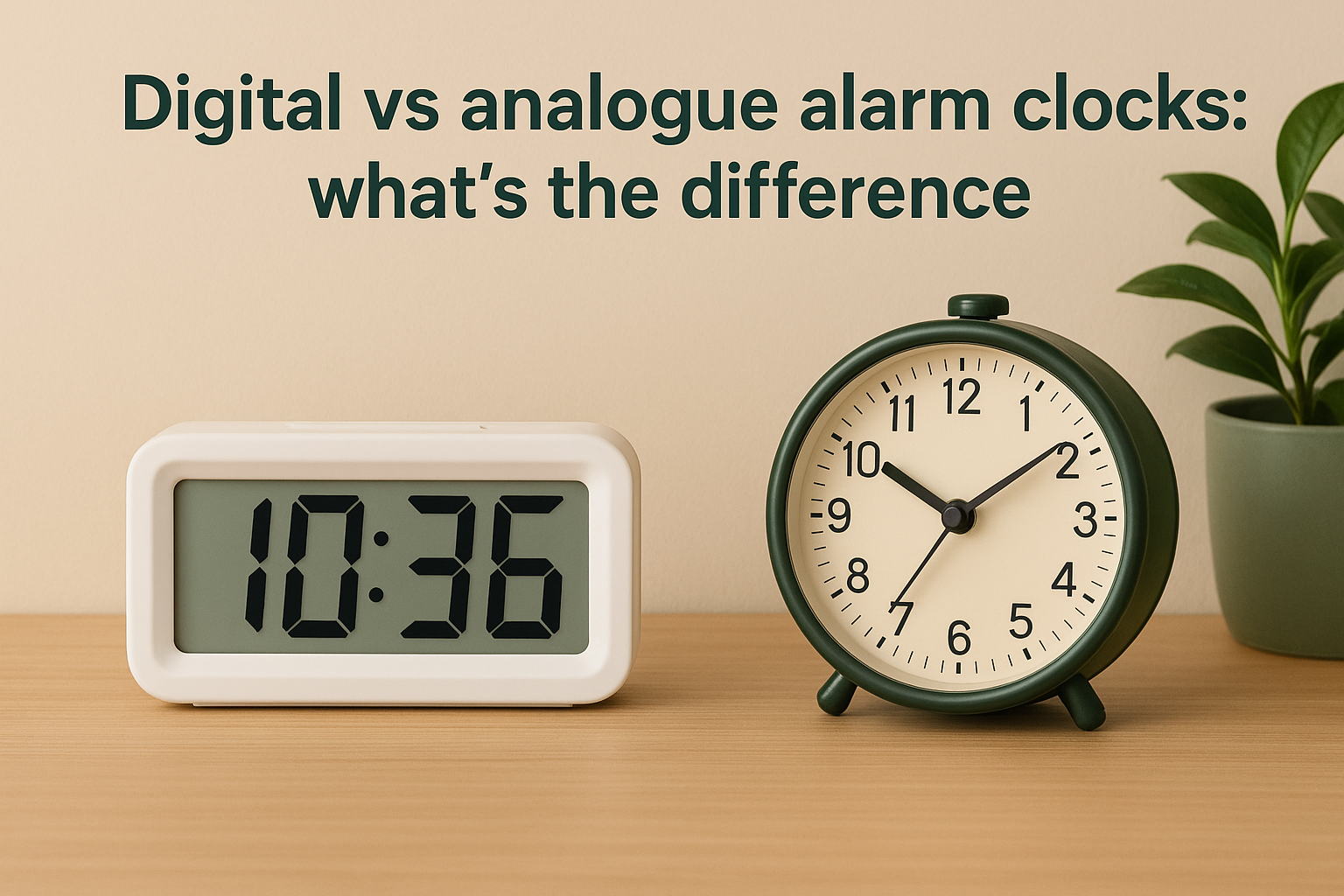
How each type actually works
Underneath the case, a digital clock relies on a small circuit board and a quartz crystal to keep time, then drives a display and speaker off the same power source. Analogue clocks, by contrast, use a quartz or mechanical movement to turn gears that move the hands, and many cheaper models tick audibly with every second. Because of that difference, a digital clock is almost always the quieter option by design, not by luck.
If a silent bedroom matters to you, the tick of an analogue movement will decide the outcome before any other feature does.
Reading the time at a glance
Glancing at a digital display in the middle of the night takes less effort than reading hands on a dial, especially without your glasses on. Numbers are unambiguous, whereas an analogue face asks your brain to do a small calculation every time, which matters less at 2pm and more at 2am when you're half-asleep and just want to know if it's worth getting up. Kids and older family members often find digital displays easier for exactly this reason.
Accuracy, upkeep and the trade-offs each style brings
Setting the alarm is generally faster on a digital clock, since most use simple button presses rather than turning small dials by hand. Analogue clocks win on aesthetics for plenty of buyers though, particularly in classic or nostalgia-style rooms where a ticking clock adds character rather than annoyance. Here's a quick side-by-side to help you weigh it up:
| Feature | Digital | Analogue |
|---|---|---|
| Noise level | Silent to near-silent | Often audible tick |
| Reading at night | Fast, unambiguous | Requires a glance and interpretation |
| Alarm setting | Button-based, quick | Dial-based, slower |
| Style fit | Modern, minimalist | Classic, nostalgic |
| Power needs | Mains or battery, often both | Battery or mechanical |
Ultimately, neither style is objectively better, it depends on whether you value silence and speed or classic styling and a bit of character on the nightstand.
Matching a digital alarm clock to your lifestyle
The best digital alarm clock for a shift worker looks nothing like the best one for a new parent, and both look nothing like what suits a teenager's desk. Lifestyle factors shape which features actually earn their keep, so it pays to think about your routine, not just your room, before you buy a digital alarm clock online. A clock that's perfect for a nine-to-five sleeper can be the wrong choice entirely for someone who sleeps in three-hour blocks.
The right clock fits your routine first, and your room second.
Shift workers and irregular sleepers
Rotating shifts mean sleeping at odd hours, often with daylight streaming through the curtains, so a fully dimmable display and blackout-friendly brightness settings matter more than they would for a standard nine-to-five sleeper. Look for models with multiple alarm presets too, since switching between an early start and a late one shouldn't mean reprogramming the clock from scratch every few days. A dual-alarm function also helps if a partner keeps standard hours while you don't.
New parents and disrupted routines
A newborn changes every part of a household's routine, including how gently you want to be woken. Parents often do better with a gradual, rising alarm tone rather than a sharp beep, since a sudden loud noise on top of broken sleep makes mornings harder than they need to be. A snooze button that's large and easy to hit in the dark is worth prioritising here too, because fumbling for a small button while exhausted defeats the purpose of a good alarm clock.
Students and shared households
Students juggling early lectures and late study sessions benefit from a clock with a genuinely low minimum volume, especially in share houses where thin walls carry noise between rooms. A USB charging port is a practical extra in this setting too, since it doubles as a phone charger on a cluttered desk. Kids' alarm clocks fit a similar brief for younger family members, just with bigger buttons and friendlier designs.
Weather-conscious and outdoor-minded buyers
Some buyers want more than time and an alarm; they want a clock that also tracks conditions outside. If that's you, a combined digital alarm clock with temperature or humidity display bridges the gap, or you can pair a bedside alarm clock with a separate weather station or barometer for the living room. Clocks Central's weather instrument range, including TFA Germany models, suits this exact crossover between bedroom function and broader household interest in the conditions outside.
Working through your own routine this way, rather than picking whatever's popular, is what turns a generic purchase into a clock you'll actually rely on every morning.
Making a confident purchase in Australia
Once you've narrowed your shortlist, the final step is checking that the retailer itself is worth trusting with your money and your address. Buying a digital alarm clock online should feel as straightforward as buying anything else, but a few quick checks before you pay save you a headache if the clock arrives faulty or isn't what you expected.
Check the shipping terms before you add to cart
Delivery costs can quietly add $10 to $15 onto a $40 clock if you're not paying attention, so look for the shipping terms before you commit to a model. Many Australian clock retailers, including Clocks Central, offer free shipping over a set spend threshold, often around $100, which is worth hitting if you're also grabbing a wall clock or weather station for the same room. Confirm the estimated delivery window too, particularly if you're buying a gift with a deadline attached.
Read the warranty and returns policy properly
Warranty length tells you how much the retailer trusts its own stock, so treat a short or vague warranty as a warning sign rather than a minor detail. Look specifically for a clear returns window stated in days, not a vague promise to "sort it out", and check whether you're covered if the alarm volume or display brightness simply doesn't suit your bedroom once you've tried it for a few nights.
A clear returns policy is the single best sign you're buying from a retailer that stands behind what it sells.
Look for secure checkout and clear contact details
Secure checkout matters more than most shoppers realise, and it's easy to verify in seconds. Run through this quick checklist before you enter any payment details:
- The web address starts with https, not just http
- A padlock icon shows next to the address bar
- Payment options include familiar methods like credit card or PayPal
- A physical address or ABN is listed somewhere on the site
- Customer service contact details are easy to find, not buried three pages deep
Trust reviews and a specialist focus over price alone
Price matters, but it shouldn't be the only factor deciding your purchase. Specialist retailers that focus solely on clocks and weather instruments, rather than general homewares, tend to know their stock better and attract more detailed customer reviews, because their buyers are shopping with specific features in mind. Weighing up warranty, returns, and reputation alongside price is what turns a rushed online purchase into one you're actually glad you made.
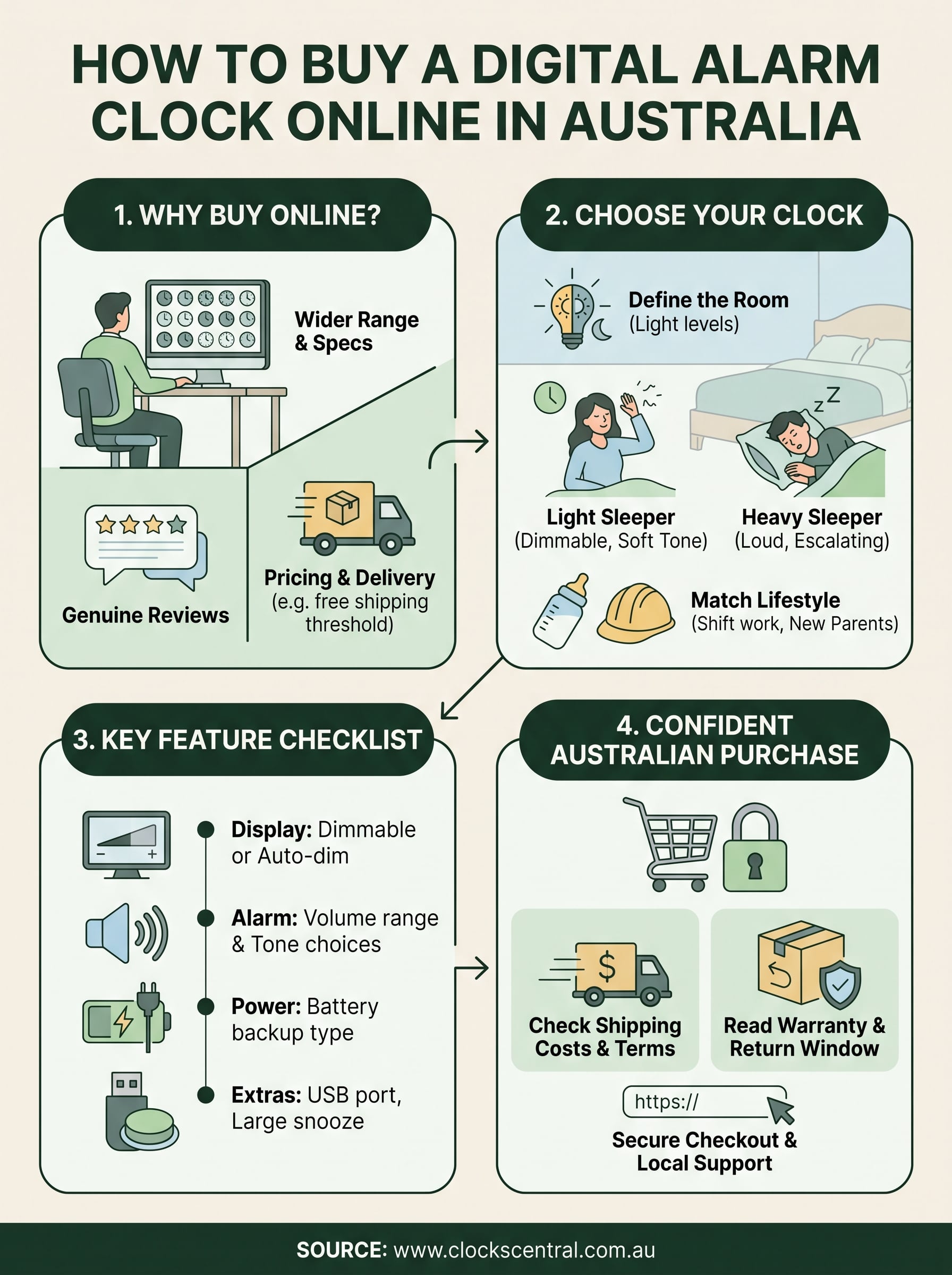
Finding the right clock for your mornings
Buying a digital alarm clock online works best when you treat it as a shortlist exercise, not a scroll-and-hope one. Room, sleeper, and lifestyle decide which features matter, and once you've written those down, comparing display brightness, alarm volume, and battery backup across a few models takes minutes rather than hours. The features that seemed optional at the start, a dimmable screen, a genuinely low volume floor, a proper returns window, are usually the ones that decide whether you actually like the clock six months from now.
Australia's specialist retailers make this easier than a general homewares aisle ever could, simply because the range and the detail are both there when you need them. If you're ready to compare models built for quiet, reliable mornings, browse Clocks Central's alarm clocks collection and find the one that actually suits how you sleep.
0 comments